InfoThis page may be partially machine translated.
”Ari raised stones over Helmet his father. God help his spirit.”
Almost a thousand years ago, Ari, who lived on Ramsjö farm, decided to erect a rune stone in memory of his father Hjälm. He gave the job to the rune carver Erik, who had made a great name for himself in Fjädrundaland (Fjärdhundraland). Erik is, for example, the author of a rune stone that stands next to Forsby kvarn and in a farm a little further south, two twin stones stand opposite each other.
This stone, however, had a slightly different life.
It was left alone for a long time but exactly where is not known. At some point in the 17th or 18th century, however, the then landowner of Ramsjö farm seems to have moved it to the courtyard next to the large yellow house that now stands on the site.
One of Gustav III's closest men, George Seton, lived with his son Alexander at Ekolsund Castle in the 18th century. At some point Alexander was in the area around Morgongåva and saw the rune stone with the large cross. The reason is not clear, but in 1787 Alexander Seton transported the stone across the North Sea to Edinburgh in Scotland. Perhaps he wanted to impress people in the old country? The stone has since stood under the castle wall in Edinburgh and over time been almost completely forgotten.
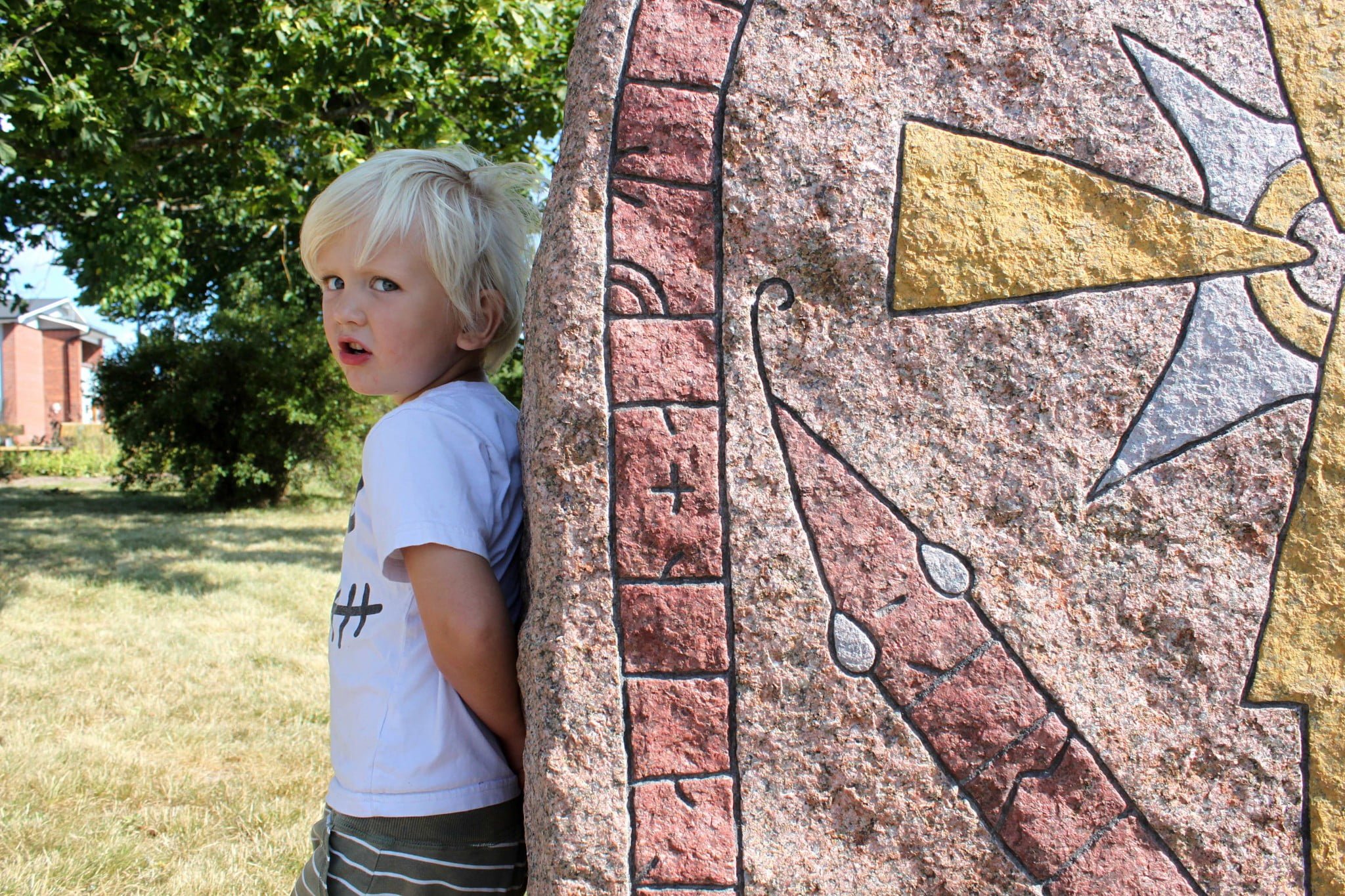
However, the Morgongåva Viking Friends Association felt that the stone belonged in Morgongåva and hired their own runic carver and historical expert, Kalle Runristare from Adelsö, to arrange this. Kalle went to Edinburgh to study the stone in detail and once back in Sweden he ordered a 1.2 ton block of granite and began to create an exact replica of it.
With pomp and circumstance, the stone was erected on September 20, 2014 in the small park next to the railway in Morgongåva. The park has also been restored with new gravel paths, benches and flower beds, allowing the stone to be seen in a welcoming environment.